
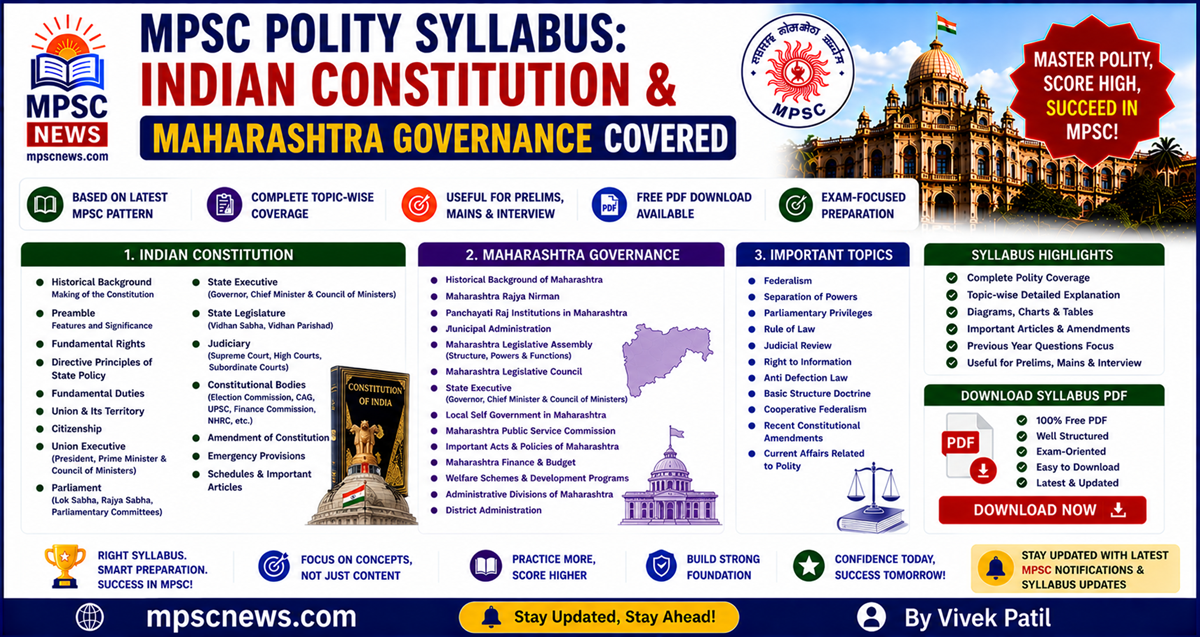
MPSC Polity Syllabus: Best Constitution & Governance Guide
Quick Answer
The MPSC Polity Syllabus covers the Indian Constitution, Fundamental Rights, Directive Principles of State Policy (DPSP), Parliament, Judiciary, Union Government, State Government, Constitutional Bodies, Panchayati Raj, Urban Governance, Public Policy, Rights Issues, and Maharashtra Governance. Polity is one of the highest-weightage subjects in MPSC Rajyaseva, Group B, and Group C examinations.
Introduction
The MPSC Polity Syllabus forms the backbone of General Studies preparation for Maharashtra Public Service Commission examinations. Questions from the Constitution, governance, political system, local self-government, and public administration appear consistently in Preliminary and Main examinations.
Candidates preparing for Rajyaseva, Group B, and Group C examinations should develop strong conceptual clarity regarding constitutional provisions, governance mechanisms, fundamental rights, and Maharashtra’s administrative structure. A well-prepared Polity section can significantly improve overall examination performance.
Overview of MPSC Polity Syllabus
| Section | Major Topics |
|---|---|
| Constitution | Features, Amendments, Articles |
| Fundamental Rights | Rights, Duties, DPSP |
| Union Government | President, PM, Parliament |
| State Government | Governor, CM, Legislature |
| Judiciary | Supreme Court & High Courts |
| Local Governance | Panchayati Raj & Municipalities |
| Governance | Public Policy & Administration |
| Constitutional Bodies | EC, CAG, UPSC, Finance Commission |
The official syllabus specifically includes Constitution, Political System, Panchayati Raj, Urban Governance, Public Policy, and Rights Issues related to India and Maharashtra.
Indian Constitution for MPSC
Historical Background
The most important Indian Constitution for MPSC topics include:
- Constituent Assembly
- Making of the Constitution
- Historical Sources
- Constitutional Development
- Salient Features of the Constitution
Questions frequently appear from constitutional evolution and key committees involved in drafting the Constitution.
Preamble
Important areas include:
- Objectives of the Constitution
- Sovereign, Socialist, Secular, Democratic Republic
- Constitutional Philosophy
- Significance of the Preamble
The Preamble is considered the soul of the Constitution and remains a frequently tested topic.
Fundamental Rights, DPSP and Duties
Fundamental Rights
Candidates should study:
- Right to Equality
- Right to Freedom
- Right Against Exploitation
- Freedom of Religion
- Cultural and Educational Rights
- Constitutional Remedies
These provisions are among the most important and frequently asked areas in MPSC examinations.
Directive Principles of State Policy
Important topics include:
- Welfare State Concept
- Social Justice
- Economic Democracy
- State Policy Objectives
Fundamental Duties
Candidates should understand:
- Constitutional Duties
- Citizen Responsibilities
- Importance in Governance
Union Government
President and Vice President
Important areas include:
- Election Process
- Powers and Functions
- Removal Procedure
- Emergency Powers
Prime Minister and Council of Ministers
Topics include:
- Appointment Process
- Powers and Functions
- Cabinet System
- Collective Responsibility
Parliament
Important topics include:
- Lok Sabha
- Rajya Sabha
- Legislative Process
- Parliamentary Committees
- Budget Procedure
Parliament-related questions regularly appear in both Prelims and Mains.
State Government
Governor
Candidates should study:
- Appointment
- Powers
- Discretionary Powers
- Constitutional Position
Chief Minister and Council of Ministers
Important topics include:
- Formation of Government
- State Executive
- Administrative Functions
State Legislature
Key areas:
- Legislative Assembly
- Legislative Council
- State Law-Making Process
State Government topics are particularly relevant for Maharashtra-focused examinations.
Judiciary
Supreme Court
Important topics include:
- Composition
- Jurisdiction
- Judicial Review
- Constitutional Interpretation
High Courts
Candidates should focus on:
- Powers and Functions
- Writ Jurisdiction
- Administrative Control
Judicial Concepts
Important areas:
- Judicial Activism
- Public Interest Litigation
- Independence of Judiciary
The Judiciary remains a core component of the constitutional framework.
Panchayati Raj MPSC Topics
Rural Local Governance
The most important Panchayati Raj MPSC topics include:
- 73rd Constitutional Amendment
- Gram Sabha
- Gram Panchayat
- Panchayat Samiti
- Zilla Parishad
Panchayati Raj is explicitly mentioned in the MPSC syllabus and receives regular coverage in examinations.
Maharashtra Panchayati Raj
Candidates should study:
- Structure of Rural Administration
- Functions of Local Bodies
- Financial Powers
- Decentralization
Questions often focus on Maharashtra-specific local governance mechanisms.
Urban Governance
Municipal Administration
Important topics include:
- Municipal Corporations
- Municipal Councils
- Nagar Panchayats
- Urban Local Bodies
74th Constitutional Amendment
Candidates should understand:
- Urban Self-Government
- Municipal Governance
- Urban Planning
- Local Development
Urban Governance forms an important component of the official syllabus.
Constitutional and Statutory Bodies
Constitutional Bodies
Important bodies include:
- Election Commission
- Finance Commission
- Comptroller and Auditor General (CAG)
- Union Public Service Commission
Statutory Bodies
Candidates should study:
- National Human Rights Commission
- Information Commission
- Vigilance Institutions
Questions from constitutional bodies are frequently asked in MPSC examinations.
Maharashtra Governance Topics
State Administration
Important areas include:
- Maharashtra Government Structure
- Administrative Departments
- State Policies
- Governance Reforms
Public Policy
Candidates should focus on:
- Welfare Schemes
- Government Programs
- Administrative Reforms
- Citizen-Centric Governance
The syllabus gives special importance to Maharashtra governance and administration.
Public Administration and Governance
Important Governance Topics
- Transparency
- Accountability
- E-Governance
- Citizen Charter
- Good Governance
- Public Service Delivery
Governance-based questions are increasingly important in modern MPSC examinations.
High-Weightage Polity Topics
Most Important Areas
| Topic | Importance |
| Constitution | Very High |
| Fundamental Rights | Very High |
| Parliament | Very High |
| Judiciary | Very High |
| Panchayati Raj | High |
| Constitutional Bodies | High |
| Maharashtra Governance | High |
Best Preparation Strategy
Step-by-Step Guide
Step 1
Complete constitutional basics first.
Step 2
Study Fundamental Rights, DPSP, and Duties thoroughly.
Step 3
Understand Parliament and State Legislature.
Step 4
Prepare Judiciary and Constitutional Bodies.
Step 5
Focus on Panchayati Raj and Urban Governance.
Step 6
Study Maharashtra Governance separately.
Step 7
Solve previous year questions regularly.
Common Mistakes Candidates Should Avoid
Common Mistakes
- Memorizing articles without understanding concepts
- Ignoring Maharashtra Governance
- Neglecting Panchayati Raj
- Skipping Constitutional Bodies
- Not revising amendments
- Ignoring current governance developments
Comparison Table
| Topic | Prelims | Mains |
| Constitution | Yes | Yes |
| Fundamental Rights | Yes | Yes |
| Parliament | Yes | Yes |
| Judiciary | Yes | Yes |
| Panchayati Raj | Yes | Yes |
| Urban Governance | Yes | Yes |
| Maharashtra Governance | Yes | Yes |
Pros and Cons
Pros
- High-scoring subject
- Concept-based preparation
- Significant weightage
- Useful across all MPSC exams
- Strong overlap with current affairs
Cons
- Requires frequent revision
- Constitutional amendments need updates
- Large syllabus coverage
- Governance topics are dynamic
Frequently Asked Questions
What is the MPSC Polity Syllabus?
The syllabus covers Constitution, Political System, Panchayati Raj, Urban Governance, Public Policy, Rights Issues, and Maharashtra Governance.
Is Indian Constitution for MPSC important?
Yes. The Constitution is one of the most important and highest-weightage sections in MPSC examinations.
Which Constitution topics are most important?
Fundamental Rights, DPSP, Parliament, Judiciary, President, Prime Minister, and Constitutional Bodies are highly important.
Is Panchayati Raj included in the syllabus?
Yes. Panchayati Raj is specifically mentioned in the official MPSC syllabus.
Are Maharashtra Governance topics important?
Yes. Maharashtra Governance receives special focus in MPSC examinations.
Is Urban Governance part of the syllabus?
Yes. Urban Governance and Municipal Administration are important syllabus components.
Which Constitutional Bodies should I study?
Election Commission, CAG, UPSC, and Finance Commission are important.
Does Polity appear in both Prelims and Mains?
Yes. Polity contributes significantly to both examination stages.
How should beginners prepare Polity?
Start with the Constitution, then move to Rights, Parliament, Judiciary, and Governance.
Where can I download the official syllabus?
Candidates can access the syllabus through the official MPSC examination syllabus section.
Final Verdict
The MPSC Polity Syllabus is one of the most rewarding subjects for MPSC aspirants. A strong understanding of the Indian Constitution, Fundamental Rights, Parliament, Judiciary, Panchayati Raj, and Maharashtra Governance can help candidates score consistently across Prelims and Mains examinations. Candidates should focus on conceptual clarity, constitutional provisions, governance mechanisms, and regular revision to maximize their performance.
Official Resources:
- MPSC Official Website – https://mpsc.gov.in/
- Official Syllabus Section – https://mpsc.gov.in/examination_syllabus/18
- Scheme of Examination – https://mpsc.gov.in/examination_scheme/17
Related Articles:
- MPSC History Syllabus – https://mpscnews.com/mpsc-history-syllabus/
- MPSC Geography Syllabus – https://mpscnews.com/mpsc-geography-syllabus/
- MPSC Rajyaseva Syllabus 2026 PDF – https://mpscnews.com/mpsc-rajyaseva-syllabus-2026-pdf/
- MPSC Group B Syllabus 2026 – https://mpscnews.com/mpsc-group-b-syllabus-2026/
- MPSC Group C Syllabus 2026 – https://mpscnews.com/mpsc-group-c-syllabus-2026/
- MPSC Previous Year Question Papers – https://mpscnews.com/mpsc-previous-year-question-papers/
- MPSC Syllabus PDF – https://mpscnews.com/mpsc-syllabus-pdf/
- Maharashtra Government Jobs – https://mpscnews.com/maharashtra-government-jobs/

- MPSC Normalization Process Explained Clearly: How Scores Are Calculated in Multi-Shift Exams 2026 - August 6, 2026
- MPSC AI-Based Exam Monitoring 2027: How Artificial Intelligence Will Change Recruitment - August 6, 2026
- MPSC Optional Subject Removed from State Services Mains 2027: Official Changes Explained - July 27, 2026